|

| Home | Crystal | jmol | jPOWD | Chem | X Ray | Dana | Strunz | Properties | A to Z | Images | Share | News | Help | About |
Optical Data
DefinitionOptical Nomenclature Optical Nomenclature used in this database.
Gladstone-Dale RelationshipThe value of the index of refraction can be calculated using chemical and physical property data if these values are missing. The relationship between chemical composition, density, and refractive index was proposed as a means of examining gasses and solutions (Gladstone, Dale(1863), Phil. Trans, 153, 317). This relationship is as follows:
The practice of using the Gladstone-Dale relationship to minerals only gives an approximation because of the effects that different crystal systems have on the anisotropy of the crystal lattice and the resultant values of n (index of refraction). The value of KP may be estimated from the value of Kc, the value of the Gladstone-Dale constant derived from the chemical composition. KC = SUM OF (k1p1/100 + k2p2/100... + knpn/100). The Gladstone-Dale constant estimated from chemical analysis
BirefringenceBirefringence is an optical property possessed by a material which has more than one index of refraction. This anisotropy in the index of refraction is dependant on the crystallographic projection and can be calculated as follows:
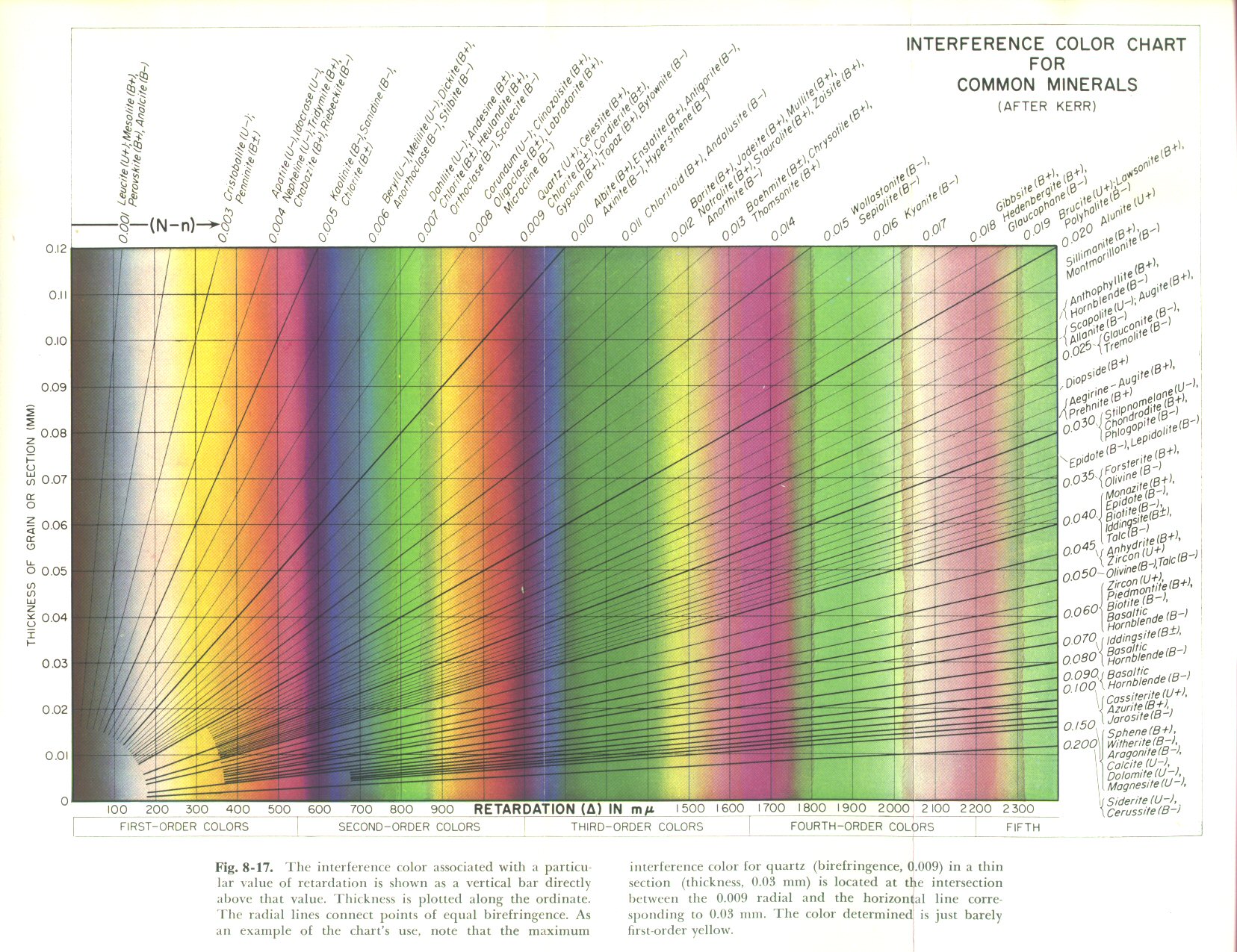
Birefringence can also be estimated from a color interference chart for colors observed under crossed polarizers on a petrographic microscope. The interference color chart is from Bloss, 1962, fig. 8-17. Click on the image for a larger picture.
Two V CalculatedTwoV(Calc) is the Biaxial 2 V angle calculated from the following relationship: Function TwoV(A, B, C) ' From Bloss, 1962, p. 156 ' ' (gamma+beta)(gamma-beta) alpha ' (sqr(--------------------------)) ----- = cos(Vz) ' (gamma+alpha)(gamma-alpha) beta where gamma=Nz, beta=Ny, and alpha=Nx DispersionDispersion is defined as the separation of a ray or beam of white light into its component colors. The common example is the separation due to a glass prism into the colors of the rainbow. Dispersion can be measured by calculating the index of refraction at different wavelengths. High dispersion materials separate the colors more effectively then low dispersion materials. High dispersion provides the "fire" in gemstones. Low dispersion materials are desirable in optical lenses. In the special case of biaxial minerals, dispersion is noted by the color fringing in acute bisectrix figures using a petrographic microscope. This fringing is due to the variation of the refractive indices of α, β, and γ (Nx, Ny, Nz) with respect to wavelength. The net result is the variation of 2V angle with wavelength. This is represented by the relative position of 2Vr for red light and 2Vv for violet light on the opposite ends of the visible spectrum. This is shortened to r and v.
Other References to Optical DataSearch the Mineralogy DatabaseExample Subject Searches
Search the Web |